
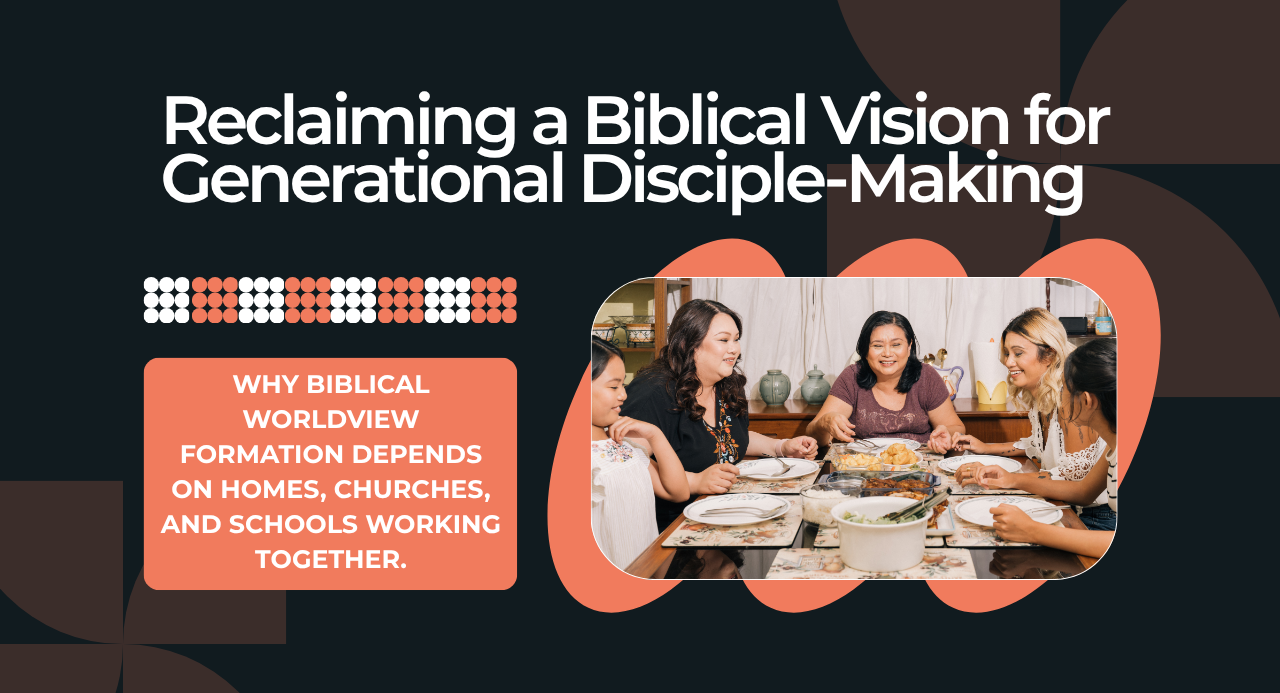
Reclaiming a Biblical Vision for Generational Disciple-Making: Why Biblical Worldview Formation Depends on Homes, Churches, and Schools Working Together
SHARE THIS POST WITH OTHERS
Something powerful happens when generations journey together in following Jesus.
An adult sits beside a child, telling a story about God answering her prayer. A teenager listens to an elder explain how Scripture has shaped his decisions over the decades of his life. Parents discover they’re not alone in discipling their children. Teachers recognize that education is about more than transferring information; it’s about forming hearts and shaping lives. Churches become integrated communities where every generation contributes, serves, learns, and grows together.
This is more than a ministry strategy. It reflects God’s design.
Throughout Scripture, God’s intention is for faith to be passed from one generation to the next. Moses instructed Israel, “Teach them (the things you’ve seen God do) to your children and to their children after them” Deuteronomy 4:9 (NIV). The psalmist declared, “One generation commends your works to another; they tell of your mighty acts” Psalm 145:4 (NIV). The biblical pattern is clear: disciple-making is a shared responsibility involving families, communities, and spiritual leaders.
Faith formation and a biblical worldview aren’t programs; they’re cultivated through relationships, reinforced through community, and practiced in everyday life. Yet many churches today face a significant challenge. The age groups are often disconnected. Even though we have ministries for the young and the old, we’re more generationally isolated than ever before.
The Challenge of Fragmented Faith Formation
For decades, churches have faithfully created ministries designed to serve specific age groups. Children’s ministry, youth ministry, adult discipleship, and senior ministries have each contributed to people’s spiritual growth. Many faithful teachers, pastors, and stakeholders have poured their lives into these activities.
But something can be lost when the ministries in a church operate independently. Children may learn Bible stories but never develop meaningful relationships with mature believers who can model a lifelong faith. Seniors may have decades of spiritual wisdom but few opportunities to invest in younger generations. Parents may want to disciple their children but feel unequipped or uncertain about their role.
The result can be a fragmented approach to disciple-making, one where faith is taught in age-segmented isolation rather than woven into the everyday routines and rhythms of life. This matters because faith formation isn’t simply about what children know; it’s about who they’re becoming.
A biblical worldview is formed when truth is encountered, practiced, modeled, and lived out in community. Every age group needs more than information about God; they need relationships with people who demonstrate what it looks like to follow Jesus. We all need to experience faith as something more than what we learn; we need to practice it as something we live.
The Church’s Role in Making Disciples And Building a Biblical Worldview
The church has a unique and essential role in this process.
The church should never replace parents as primary disciple-makers, nor should schools alone carry the weight of spiritual formation. Building a biblical worldview requires a partnership where families, churches, and schools work together toward a common purpose: helping successive generations know, love, and follow Jesus.
Pastors are uniquely positioned to help create and coordinate this collaboration. Rather than viewing children, youth, adults, and seniors as separate audiences, churches can begin to see themselves as a family of families on mission together.
This doesn’t mean we should eliminate age-specific ministries. Children need environments where they can learn at their level. Young people need opportunities to engage with the issues they’re facing. Adults and seniors likewise require ministry tailored to their age and stage of life.
But alongside age-specific ministries, churches need intentional activities and opportunities to connect intergenerationally for worship, teaching, and service.
Imagine churches where:
- Children regularly hear testimonies from older believers about God’s faithfulness.
- Families are equipped and encouraged to cultivate faith at home.
- Seniors are invited to mentor, pray for, and invest in younger generations.
- Students experience adults beyond their parents who know their names and care about their spiritual journey.
- Schools, churches, and families communicate and collaborate around the shared goal of equipping and encouraging lifelong resilient disciples.
This isn’t just a nice idea. It’s deeply biblical.
The Vital Partnership of Christian Schools
Christian schools also play a significant role in disciple-making. Education is never spiritually neutral. Every classroom communicates a view of the world: where we came from, who we are, what matters most, and how we should live. The question isn’t whether students will develop a worldview, but which worldview will shape them.
Christian education can help students see that faith isn’t confined to Sunday mornings or personal devotion. Biblical truth speaks into and is activated in every area of life. When educators intentionally connect Scripture to learning, they help students understand that God is Lord over all creation. Science reveals His creativity. History reveals His providence. Literature explores questions of identity, morality, and purpose. Social studies are shaped by His command to love God and love others. Christian schools can’t replace or replicate the role of parents or churches, but they can reinforce the biblical worldview taught in the home and within the church community.
When these three partners, the home, church, and school, work together, children and young people receive a consistent message: God’s truth is relevant everywhere.
Moving from Ministry Consumers to Kingdom Contributors
One of the greatest shifts that homes and churches can make is moving from a consumer mindset to one in which everyone participates in God’s mission. Jesus didn’t create disciples by placing people in age-segmented silos. He invited ordinary people of different backgrounds and ages to walk with Him, learn from Him, serve alongside Him, and participate in His mission.
This should be the same invitation today. Children are more than the future church. If they follow Jesus, they’re part of the church now, and should be actively involved in proclaiming the Good News of Jesus with clarity, courage, and conviction.
At the other end of the spectrum, older believers shouldn’t retire from ministry. Their spiritual wisdom and testimonies of God’s grace are invaluable. As God provides health and strength, they must tell the next generation about the wisdom, wonders, and works of the Lord (Psalm 78:4)
Every generation has something to receive and every generation has something to give. When generations worship and work together, the church becomes a living picture of God’s kingdom: a place where truth is shared, faith is strengthened, and disciples are formed.
A Call to Pastors and Leaders
The task before us isn’t something superficial. What we’re aiming for is finding better ways to create environments where faith is formed. Programs have value, but relationships transform. Events can inspire, but shared life shapes us. Teaching is essential, but truth becomes powerful when it’s lived out.
Pastors and leaders have opportunities to lead churches toward a more integrated vision of disciple-making: one where homes are strengthened, schools are supported, and every generation recognizes its calling in God’s mission. Resilient faith and a comprehensive biblical worldview won’t be built by a ministry team, an organization, or one generation working alone. It happens when families, churches, and schools recognize they’re partners in a sacred assignment.
The baton of faith was never meant to be carried by one generation in isolation. It was always meant to be passed carefully, intentionally, and joyfully from one generation to the next. Because God’s mission is too important to keep to ourselves, it’s meant to be shared. Together.
The Author

Lawson is a follower of Jesus. He’s married to his best friend, Karen. They love spending time together with their married children and twelve grandchildren. Lawson is deeply committed to connecting children, youth, and families with Jesus and His Word. He is a writer/author, researcher, ministry innovator, conference speaker, adjunct seminary professor, international trainer, Bible engagement specialist, children’s, family, and sports ministry specialist, and President of Scripture Union Canada.
www.christianparentingbasics.com